The Ecosystemic Transition hUb (ETU) for Green Living Areas
Shared solutions for local action
1. What is the ETU Initiative?
The Ecosystemic Transition hUb (ETU) is an initiative of the Interreg Euro-MED Green Living Areas Mission, created to support local authorities in planning and implementing the green transition in their territories.
Through the ETU, cities and regions across the Mediterranean can access practical solutions, connect with solution providers and peers, and learn from tested experiences to make their territories more sustainable, resilient, and inclusive.
Building on several years of work under the Interreg MED Programme, the ETU serves as a shared framework and community of practice, bringing together tools, methods, and actors working to create greener living areas — from energy and mobility to urban nature and local governance.
2. Origin and Evolution
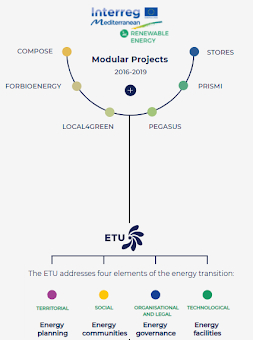
The ETU was first developed under the Interreg MED Renewable Energy Community as the Ecosystemic Transition Unit, supporting rural and island municipalities in implementing their renewable energy transition through a systemic approach addressing four key elements: energy planning, energy communities, energy governance, and energy facilities.
With the launch of the Green Living Areas Mission, the concept evolved into the Ecosystemic Transition hUb (ETU) — broadening its focus from renewable energy to the overall green transition of territories.
Today, the ETU serves as a hub connecting projects, solution providers, and local authorities to exchange experiences, transfer solutions, and co-create greener living areas across the Mediterranean.
3. What do we mean by “Ecosystemic Transition”?
– The concept
An ecosystemic transition recognises that territories function as interconnected systems — where actions in one domain, such as energy, mobility, or land use, directly influence others, as well as the economy, social well-being, and resilience of communities.
It calls for integrated, multi-level, and cross-sectoral planning, ensuring that local decisions work together to create greener, more liveable, and inclusive territories.
– The ETU pillars (the six dimensions of the transition)
To translate this holistic vision into practice, the ETU framework is built around six pillars, which represent the main dimensions that need to evolve together for a successful transition:
- Organisational – governance, policy coherence, and capacity building.
- Environmental – protection and restoration of ecosystems and natural resources.
- Social – community engagement, equity, health, and well-being.
- Territorial – sustainable land use and urban design.
- Technological – smart solutions and infrastructures for efficient management.
- Financial – improved access to and management of financial resources for local transitions.
– The ETU matrix
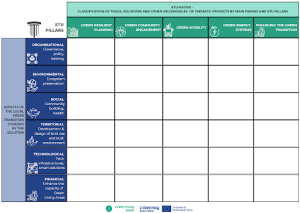
The ETU Matrix helps us structure and connect the different solutions developed across the Green Living Areas Community.
It combines these six pillars with five key themes of local transition — green resilient planning, green energy systems, green mobility, green community engagement, and financing the green transition.
By linking the themes and pillars, the Matrix allows us to organise and present a coherent set of solutions that together reflect the ecosystemic nature of the green transition of territories.
It ensures that the tools and approaches we offer to local authorities cover all relevant dimensions.
4. Why a “Hub”?
The Ecosystemic Transition hUb (ETU) is more than a framework — it is a space for connection and collaboration.
Its purpose is to bring together the people and organisations driving the green transition across the Mediterranean: solution providers, projects, experts, and local authorities working to make their territories more sustainable and resilient.
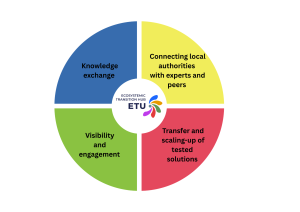 By acting as a hub, the ETU facilitates:
- Knowledge exchange – linking solutions developed by different projects and programmes, from the GLA community but also from outside.
- Connecting local authorities with experts and peers who have faced similar challenges.
- Transfer and scaling-up of tested solutions – supporting the adaptation of tested solutions in new contexts, multiplying their impact.
- Visibility and engagement – giving voice to actors leading the transition at local and regional levels.
The ETU also ensures that these solutions are accessible and meaningful for local authorities. Through its online platform, users can:
- Explore a curated collection of tested solutions, tools, and methods structured around the ETU Matrix;
- Discover where solutions have been tested and what results they produced;
- Identify contacts and networks to learn from or collaborate with.
In this way, the ETU serves as both a knowledge hub and a community of practice.
5. A hUb supporting local planning and implementation
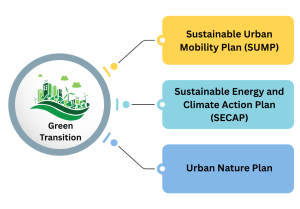 The Ecosystemic Transition hUb (ETU) is designed to inspire and guide local authorities in developing and implementing more integrated and actionable local plans for the green transition, building on the latest knowledge and experiences of the Green Living Areas Community of Practice.
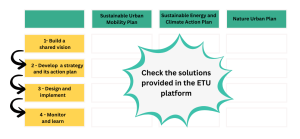
More specifically, the ETU contributes to the three essential local plans that guide the green transition at territorial level:
– Sustainable Urban Mobility Plans (SUMP)
SUMPs provide a long-term vision for sustainable mobility, going beyond transport infrastructure to integrate accessibility, health, and spatial planning.
Through the ETU solutions, cities and regions can explore innovative approaches such as
autonomous mobility on demand, green and inclusive mobility hubs, solutions for energy-efficient public transport systems, collaborative logistics for urban spaces, electric mobility in rural areas, tactical urbanism, and citizen participation. These solutions help make mobility planning low-carbon, inclusive, and resilient.
– Sustainable Energy and Climate Action Plans (SECAP)
SECAPs help local authorities plan and implement renewable energy, energy efficiency, and climate mitigation and adaptation actions across their territories.
Through the ETU solutions, cities and regions can access tools such as dashboards for the green and just transition, digital platforms for citizen participation, and toolkits for developing renewable energy communities in both urban and rural areas. They can also benefit from financial and economic evaluation tools for carbon neutrality and climate adaptation projects, innovative financing schemes, local energy transition planning tools, approaches for developing ports as clean energy hubs, climate neutrality scenarios for islands, platforms supporting climate-resilient spatial planning, as well as guidance for integrating local action plans to address extreme heat waves.
Together, these resources help local authorities design integrated, ecosystemic climate strategies that strengthen resilience, accelerate the transition to carbon neutrality, and support effective climate adaptation.
– Sustainable Energy and Climate Action Plans (SECAP)
Urban Nature Plans guide the integration of nature-based solutions, ecosystem restoration, and biodiversity protection into urban spatial planning.
Through ETU examples and tools, local authorities can learn how to reconnect urban with green spaces, access catalogues of nature-based solutions, and involve citizens in the design of green areas. The ETU also provides approaches to improve resilience to extreme heat waves, transform schoolyards to combat climate change effects and promote healthy environments, and apply holistic models to co-design and co-manage healthy, multifunctional, and climate-resilient urban green spaces.
Together, these solutions help improve quality of life, enhance climate adaptation, and create greener, healthier living environments.
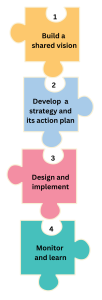 Through the ETU Hub, local authorities can access a rich collection of tested solutions, methods, digital tools, and practical examples to support them at each step of the planning process:
- Build a shared vision and diagnose local challenges;
- Develop integrated and participatory strategies and action plans;
- Design and implement concrete actions; and
- Monitor and learn from ongoing initiatives.
By connecting knowledge from across the Mediterranean, the ETU helps local authorities strengthen their plans, accelerate implementation, and make their territories more sustainable, resilient, and inclusive.
Whether you are a local planner, a decision-maker, or a project partner, the ETU Hub helps you find inspiration, connect with peers, and move from ideas to action.